
Managed service provider companies are third-party firms that take full or partial responsibility for a business's IT operations under a fixed, recurring contract. The model replaces unpredictable break-fix costs with proactive, continuous support. 85% of businesses report exceptional support reliability after switching to managed IT services, and 70% see measurable improvements in network security and cost stability. That level of consistency is not accidental. Top-performing MSPs apply structured IT service management frameworks, such as ITIL and ISO/IEC 20000, to deliver repeatable outcomes rather than one-off fixes. For business leaders evaluating outsourced IT support, understanding how these firms operate is the first step toward making a sound decision.
What do managed service provider companies actually do?
MSPs are often misunderstood as reactive helpdesks, but that description misses the point entirely. True managed IT services include continuous monitoring, patch management, cybersecurity, compliance support, and strategic planning. The distinction matters because reactive support only responds to failures. Proactive MSP support prevents them.
A mid-level in-house IT hire costs $70,000–$90,000 annually including benefits and training. A full outsourced team through an MSP operates on a predictable flat monthly fee that typically costs a fraction of that figure. For growing businesses without the budget for a full internal IT department, that math is decisive.

Cybersecurity is now a core MSP function, not an add-on. Modern technology service firms handle patching, threat monitoring, protective tooling, and compliance with regulations like GDPR. MSPs also provide both remote and on-site support, with remote handling covering most routine fixes and on-site engineers stepping in for complex installations or hardware issues.
How do MSPs implement IT service management frameworks?
Managed IT services and IT service management are related but distinct concepts. ITSM is the structured framework that governs how IT work gets done. MSPs outsource the work itself. The best MSPs combine both: they deliver outsourced IT while applying ITSM discipline to keep service quality consistent.
Organizations adopt ITSM frameworks primarily to improve service quality (48%) and customer experience (35%). Those numbers reflect why ITSM-mature MSPs outperform their less structured peers. When an MSP runs on documented workflows, defined escalation paths, and measurable service-level agreements, clients get predictable outcomes rather than heroic one-off efforts.
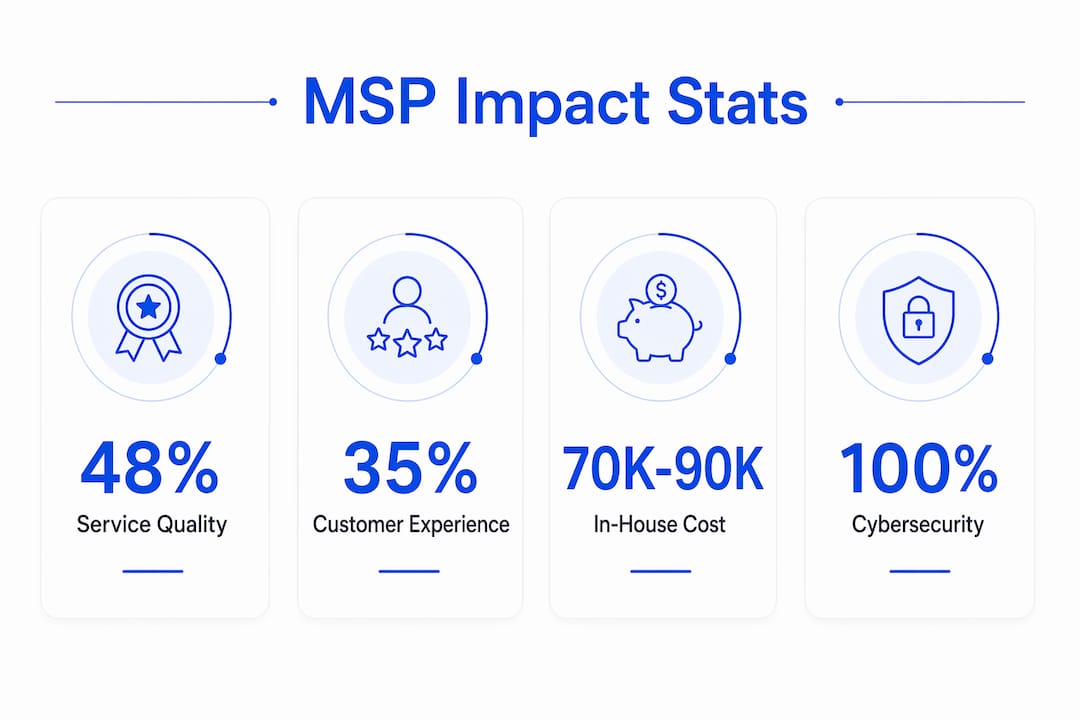
ITIL, the most widely adopted ITSM standard, defines the service desk as the single point of contact for incident management and user communication. MSPs that build their operations around this principle give clients a clear, consistent experience every time something goes wrong. ISO/IEC 20000 takes that further by certifying that an MSP's entire service management system meets an audited international standard.
Key ITSM practices that distinguish high-performing MSPs include:
- Documented change management: Every system change follows an approval and rollback process, reducing outage risk.
- Defined incident and problem management: Incidents get resolved fast; root causes get addressed permanently.
- Service-level agreements with teeth: SLAs specify response times, uptime guarantees, and escalation triggers.
- Capacity and availability planning: MSPs forecast resource needs before bottlenecks hit.
- Continuous service improvement: Regular reviews identify gaps and drive measurable progress.
Pro Tip: Ask any MSP candidate to show you their incident management workflow before signing a contract. If they cannot produce a documented process on the spot, their ITSM maturity is low.
Fully managed vs. co-managed IT: which model fits your business?
The choice between fully managed and co-managed IT services is one of the most consequential decisions a business leader makes when engaging an MSP. Getting it wrong means either paying for services you do not need or leaving your internal team without the support they require.
Fully managed IT means the MSP takes complete ownership of your IT environment. Your internal staff handles no IT operations. This model suits organizations without an existing IT team, businesses that want total cost predictability, and companies where IT is not a core competency. The MSP monitors, maintains, secures, and supports everything under one contract.
Co-managed IT is a partnership model. Your internal IT team retains ownership of strategic decisions and specialized systems, while the MSP handles routine tasks like maintenance and tier-1 tickets. This frees your internal staff to focus on projects that move the business forward rather than resetting passwords and chasing printer errors.
| Criteria | Fully managed IT | Co-managed IT |
|---|---|---|
| Internal IT team required | No | Yes |
| Best for | SMBs without IT staff | Mid-market with existing IT |
| Cost structure | Single flat monthly fee | Shared cost between MSP and internal team |
| Control level | MSP holds full operational control | Internal team retains strategic control |
| Flexibility | Lower, MSP sets the scope | Higher, scope is negotiated |
Pro Tip: Co-managed IT works best when you document which responsibilities belong to your internal team and which belong to the MSP before day one. Ambiguity in that boundary creates gaps in coverage.
How are MSPs evolving with AI and automation?
The most forward-looking managed network services firms are no longer positioning themselves as IT support vendors. They are positioning as what the industry now calls "Managed Experience Providers." This shift reflects a fundamental change in what clients expect from outsourced IT support.
AI-driven MSPs integrate automation and machine learning to move from reactive ticket resolution to predictive and self-healing operations. A system that detects a failing hard drive before it crashes and replaces it during a maintenance window is worth far more than one that responds after the crash. That is the operational difference between a traditional MSP and an AI-integrated one.
The business impact of this evolution includes:
- Proactive monitoring at scale: AI tools watch thousands of endpoints simultaneously, flagging anomalies before they become outages.
- Automated patch deployment: Security patches roll out on schedule without manual intervention, closing vulnerabilities faster.
- Self-healing workflows: Common issues like service restarts or disk cleanup trigger automatically, reducing ticket volume.
- Strategic reporting: AI-generated insights give business leaders visibility into IT performance trends, not just incident counts.
- Alignment with business goals: High-performing MSPs use data to connect IT investments directly to revenue and growth metrics.
Tasklyte takes this model further by combining AI-assisted execution with rigorous quality assurance across business functions. Clients report an average ROI of 10.1 times across case studies, which reflects what happens when AI-powered managed services focus on outcomes rather than activity.
How to choose the right managed service provider company
Selecting an MSP is not a procurement exercise. It is a partnership decision that affects your security posture, operational continuity, and internal team's capacity for years. Speed of response is the wrong primary criterion.
Prioritizing speed over repeatable process leads to instability. An MSP that resolves tickets fast but lacks documented workflows will create new problems as fast as it solves old ones. Governance and process maturity predict long-term reliability far better than response time benchmarks.
Use this framework when evaluating MSP candidates:
- Ask for their documentation standard. High-performing MSPs maintain detailed records of every client environment. This prevents vendor lock-in and ensures knowledge continuity if you ever change providers.
- Review their ITSM certifications. ITIL-trained staff and ISO/IEC 20000 certification signal process maturity. Ask which frameworks they follow and how they measure service quality.
- Examine their security practice. Cybersecurity must be built into the service, not sold as an add-on. Ask specifically about patch cadence, threat monitoring tools, and compliance support.
- Test their escalation path. Ask what happens when a critical system fails at 2:00 AM on a Sunday. The answer reveals whether their SLAs have real operational backing.
- Evaluate cultural fit. The best MSP relationships work because the provider understands your business goals, not just your tech stack. Ask how they align IT decisions with your growth plans.
Pro Tip: Request a sample of the documentation they maintain for a current client (redacted for confidentiality). The quality of that document tells you more about their operational discipline than any sales presentation.
Key Takeaways
The most reliable managed service provider companies combine ITSM process maturity, documented governance, and proactive AI-driven monitoring to deliver consistent, measurable IT outcomes for their clients.
| Point | Details |
|---|---|
| MSPs go beyond helpdesk | Proactive monitoring, cybersecurity, and compliance support define modern managed IT services. |
| ITSM frameworks drive quality | MSPs using ITIL and ISO/IEC 20000 deliver more consistent outcomes than those without structured processes. |
| Model selection matters | Fully managed IT suits businesses without internal IT staff; co-managed IT suits those with existing teams. |
| AI integration is now standard | Leading MSPs use automation and AI to shift from reactive support to predictive, self-healing operations. |
| Process beats speed in selection | Documented workflows and governance predict long-term MSP reliability better than ticket response times. |
Why I think most businesses choose MSPs for the wrong reasons
Most business leaders I have spoken with chose their MSP because of price or because a peer recommended them. Both are reasonable starting points. Neither is sufficient.
The MSP relationship fails most often not because of technical incompetence but because of misaligned expectations. A business expects a strategic partner. The MSP delivers a support desk. That gap is almost always visible in the sales process if you know what to look for. An MSP that talks only about response times and ticket volumes in the first meeting is telling you exactly what they think their job is.
The businesses that get the most value from managed IT services treat the MSP as an extension of their internal team, not a vendor they call when something breaks. That means sharing business goals, including the MSP in technology planning conversations, and measuring success against operational outcomes rather than ticket closure rates.
The other mistake I see repeatedly is choosing an MSP that promises the fastest onboarding. Speed in onboarding usually means shortcuts in documentation and process setup. Those shortcuts become your problem six months later when a key engineer leaves the MSP and no one else knows how your environment is configured. Slow, thorough onboarding is a feature, not a flaw.
— Kambros
Tasklyte brings managed services into the AI era
Business leaders who want the operational benefits of managed IT services without the complexity of managing multiple vendors now have a better option.
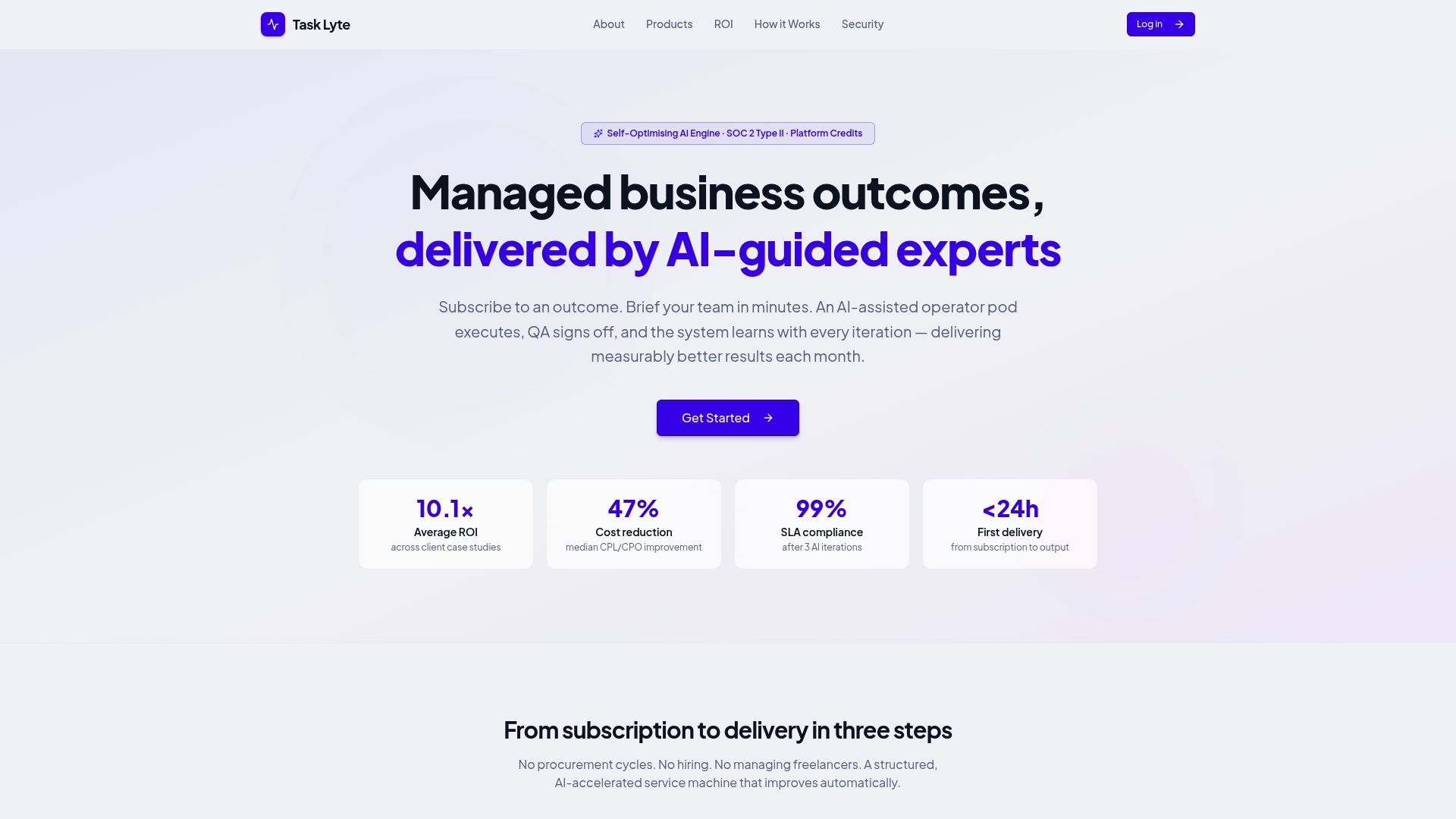
Tasklyte is an AI-powered managed services platform that converts complex business functions into fixed monthly subscriptions. Instead of hiring freelancers, negotiating contracts, or managing vendor relationships, teams subscribe to specific outcomes. Whether the need is demand generation, legal review, or IT operations support, Tasklyte's AI-assisted execution layer handles delivery while its quality assurance process holds every output to a high standard. Clients achieve an average ROI of 10.1 times across case studies. The platform's continuous learning mechanism means service quality improves over time, not just at launch.
FAQ
What is a managed service provider company?
A managed service provider company is a third-party firm that takes ongoing responsibility for a business's IT operations under a fixed contract. Services typically include monitoring, cybersecurity, help desk support, patch management, and strategic IT planning.
How much do managed IT services cost compared to in-house IT?
A mid-level in-house IT hire costs $70,000–$90,000 annually including benefits and training. A full outsourced team through an MSP typically operates at a fraction of that cost under a predictable flat monthly fee.
What is the difference between fully managed and co-managed IT?
Fully managed IT means the MSP handles all IT operations with no internal IT team required. Co-managed IT is a partnership where the MSP handles routine tasks while your internal team retains control of strategic decisions and specialized systems.
Why does ITSM matter when choosing an MSP?
ITSM frameworks like ITIL and ISO/IEC 20000 give MSPs the structured processes needed to deliver consistent, measurable service quality. MSPs without ITSM maturity tend to resolve issues reactively rather than preventing them systematically.
How are MSPs using AI in 2026?
Leading MSPs now use AI for proactive monitoring, automated patch deployment, and self-healing workflows that resolve common issues without human intervention. This shift moves managed IT services from reactive support to predictive operations aligned with business growth.