
A failing business is defined by one condition: cash leaving faster than it arrives, with no clear plan to reverse it. Knowing what to do when your business is failing starts with stopping that cash bleed immediately, not with rebranding or hiring consultants. The standard industry term for this process is "business turnaround," a structured recovery method used by restructuring professionals worldwide. A typical turnaround spans 9–18 months, with the first 30 days carrying the most weight. Get those 30 days right, and you create the conditions for every step that follows.
What to do when your business is failing in the first 30 days
The first month of a turnaround is financial triage. Your only goal is to stop cash from leaving the business faster than necessary while buying yourself time to think clearly.
- Build a 13-week rolling cash forecast. Update it every week without exception. This single tool tells you exactly how many days of runway you have and forces every spending decision to be grounded in reality rather than optimism.
- Freeze non-essential spending immediately. Pause all hiring, subscriptions, and discretionary expenses that do not directly generate revenue. Every dollar saved in week one is a dollar that extends your decision window.
- Renegotiate payment terms. Call your top five suppliers and your largest customers within the first week. Ask suppliers for extended payment terms and ask customers for faster payment in exchange for a small discount.
- Communicate with your bank within 14 days. Proactive communication with lenders prevents trust breakdown and keeps credit lines open. Banks respond far better to early honesty than to a missed payment with no explanation.
- Call a stand-still board meeting within 48 hours. A formal, minuted board meeting within 48 hours of recognizing distress legally protects directors by documenting their prompt response and intention to seek professional advice. This step is not optional if you want to avoid personal liability.
Pro Tip: Classify your creditors by enforcement capability before you start negotiating. HMRC and secured lenders can disrupt your business fastest. Landlords and key suppliers come next. Manage the most dangerous creditors first, and you preserve operational continuity while you work through the rest.
Directors should also set a hard solvency review date 14–21 days from the moment distress is recognized. This review determines whether informal rescue is viable or whether formal insolvency procedures are required. Skipping this step is where personal legal risk begins to accumulate.

How do you diagnose the real problems in a struggling company?
Stabilizing cash buys you time. Diagnosing the real problems tells you what to do with that time. Most owners skip this step and cut costs indiscriminately. That produces a smaller business with the same broken model.
Start with 12 months of financials. Group every expense and every revenue source by category. The goal is to calculate the true profitability of each customer and each product or service line, not just gross revenue. What you find will surprise you.
- Unprofitable customers. A significant portion of your customer base, often 20–30%, consumes more resources than they generate in margin. Your top clients are quietly subsidizing them. Cutting or repricing these accounts frees up capacity immediately.
- Low-margin product lines. Products that sell well but carry thin margins drain production, fulfillment, and support resources. Identify them and decide whether to reprice, reduce, or eliminate them.
- Non-revenue activities. Conduct a time audit across your team. List every recurring task and ask whether it directly supports revenue or customer retention. Activities that fail both tests are candidates for elimination.
- Execution errors. Poor customer service or technology faults can cost businesses 1–3% of profit margin daily. These losses are invisible until you look for them specifically.
Pro Tip: After your diagnostic, write down your top 10 priorities. Then cross out seven of them. Narrowing focus to 3–5 high-impact priorities and your most profitable customer cohorts is the single most effective recovery move most owners refuse to make.
The diagnostic phase typically takes two to three weeks. Resist the urge to act before it is complete. Cutting costs before you understand profitability by customer and product is the most common reason turnarounds fail at this stage.
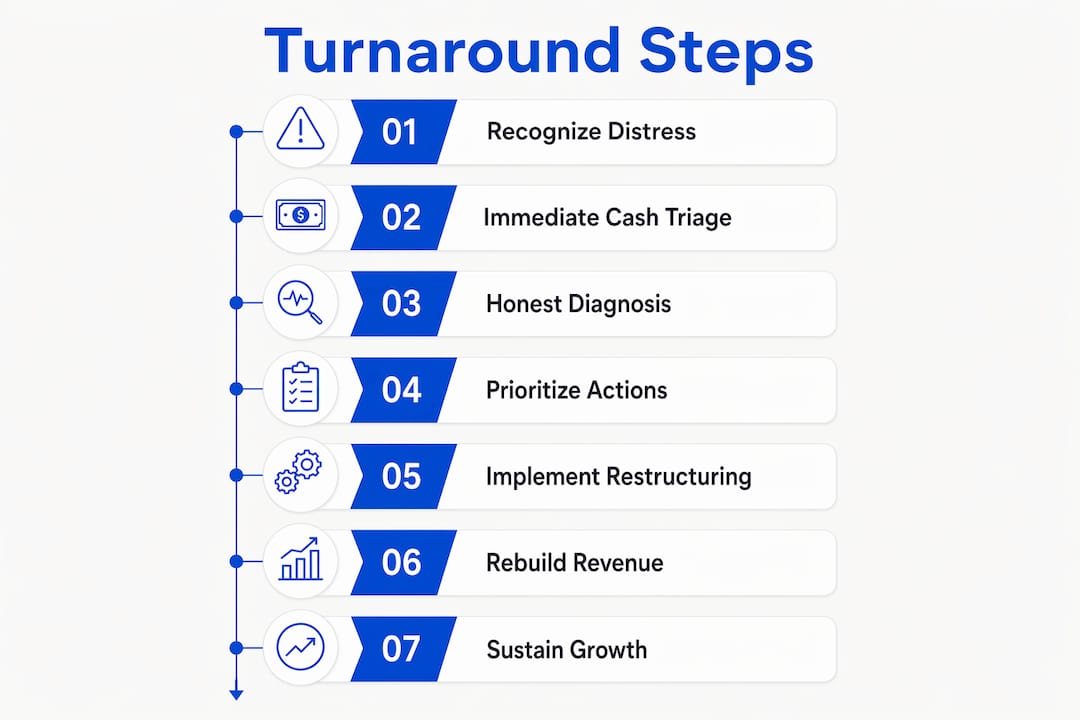
What operational restructuring actually looks like
Restructuring is not about cutting everything in sight. It is about matching your cost base to the revenue level your business can realistically sustain after stabilization.
Effective restructuring targets a 15–25% reduction in operating expenses aligned with a viable revenue model. That number sounds large, but it becomes manageable when you have completed the diagnostic work first.
- Renegotiate every major contract. Suppliers, landlords, and service providers expect distressed clients to go silent. Do the opposite. Transparent disclosure of your situation often generates concessions of 20% or more because vendors prefer a reduced payment to a defaulted one.
- Restructure headcount carefully. Payroll is usually the largest cost, but cutting people is the last resort, not the first. Before redundancies, consider moving roles to part-time, converting fixed salaries to performance-based pay, or replacing full-time positions with contract roles for non-core functions.
- Eliminate discretionary spend with no revenue link. Office perks, conference budgets, and marketing experiments with no measurable return come off the budget immediately.
- Increase management cadence. Move from monthly financial reviews to weekly ones. Weekly visibility catches problems before they become crises and keeps the team focused on the metrics that matter.
The trap most owners fall into is cutting costs without understanding which parts of the business are actually profitable. Indiscriminate cost-cutting produces a smaller but still broken business model. Every cut must be tested against one question: does removing this expense improve or damage the profitability of our core operation?
| Restructuring action | Risk if skipped | Expected benefit |
|---|---|---|
| Contract renegotiation | Continued full-cost obligations | 20%+ cost reduction on major contracts |
| Headcount review | Payroll exceeds viable revenue base | Aligns labor costs to sustainable output |
| Weekly financial reviews | Late detection of new cash problems | Early intervention before crises escalate |
| Cutting non-revenue activities | Resources drain profitable operations | Frees capacity for high-margin work |
How do you rebuild revenue after stabilizing the business?
Revenue rebuilding starts with your existing customers, not new ones. Acquiring a new customer costs far more than retaining or expanding an existing relationship. Your profitable customer base is your fastest path back to positive cash flow.
- Reactivate dormant customers. Pull a list of customers who bought from you 6–18 months ago and stopped. A direct outreach call or email explaining what has changed in your offer converts a meaningful percentage of them at near-zero acquisition cost.
- Upsell and cross-sell to your best accounts. Your top 20% of customers by margin are already sold on your value. Offer them adjacent services or higher-tier options before spending a dollar on new customer acquisition.
- Double down on your highest-converting channel. Before testing new markets or platforms, maximize the channel that already works. If referrals drive 60% of your new business, build a formal referral program before investing in paid advertising.
- Raise prices for new customers first. Price increases are necessary but must be sequenced carefully. New customers accept current market pricing without comparison. Existing customers need advance notice and a clear rationale.
Pro Tip: Delay any new growth investment until you have three consecutive months of positive cash flow and improving margins. Premature reinvestment is one of the most common ways a recovering business slides back into distress.
The revenue rebuilding phase is where turnaround management skills shift from crisis stabilization to growth execution. These are different skill sets. The leader who was right for the first 90 days may not be the right person to lead the next 12 months. Recognizing that distinction early saves significant time and money.
Key Takeaways
A successful business turnaround requires immediate cash triage, honest diagnosis of unprofitable areas, disciplined cost restructuring, and a revenue rebuild focused on existing profitable customers before any new growth investment.
| Point | Details |
|---|---|
| Stop cash bleed first | Build a 13-week rolling cash forecast and freeze non-essential spending within the first week. |
| Diagnose before cutting | Calculate true profitability by customer and product line before making any cost reductions. |
| Restructure with precision | Target 15–25% cost cuts aligned to viable revenue, not across-the-board slashes. |
| Communicate early | Contact banks and key stakeholders within 14 days to preserve trust and operational stability. |
| Rebuild revenue from existing customers | Reactivate dormant accounts and upsell top clients before investing in new customer acquisition. |
Why most turnarounds fail before they start
I have watched business owners in distress make the same mistake repeatedly. They treat a turnaround like a growth sprint. They add a new product line, hire a marketing agency, or rebrand the company when what the business actually needs is subtraction.
The instinct to add complexity during a crisis is almost universal, and it is almost always wrong. Every new initiative consumes cash, management attention, and team capacity. A business in distress has none of those resources to spare. The owners who recover fastest are the ones who get comfortable saying no to everything that does not directly support cash flow or margin in the next 90 days.
Leadership capability is the other factor that rarely gets discussed honestly. The skills required to stabilize a distressed business, rapid decision-making, creditor negotiation, and brutal prioritization, are genuinely different from the skills required to scale a healthy one. I have seen founders who built great companies completely freeze during a turnaround because they were operating outside their natural skill set. Recognizing that gap and bringing in the right support is not a sign of failure. It is the most important decision you can make.
The 9–18 month timeline is real. Recovery is not a 30-day fix. Owners who expect a quick return to normal quit the process too early, usually right before the restructuring starts to produce results. Patience, combined with weekly metrics and clear priorities, is what separates businesses that recover from those that close.
— Kambros
How Tasklyte helps you stay focused during a turnaround
Knowing the right steps is one thing. Executing them consistently while managing a distressed business is another problem entirely.

Tasklyte is an AI-powered managed services platform that delivers specific business outcomes through fixed monthly subscriptions. During a turnaround, that means you get structured execution support for the activities that matter most: weekly cash tracking, customer segmentation, and operational prioritization, without adding headcount or managing multiple vendors. Tasklyte clients report an average ROI of 10.1 times across case studies, and the platform's continuous learning mechanism improves delivery quality over time. For a business in recovery mode, that combination of cost certainty and measurable output is exactly what the situation requires.
FAQ
What are the first signs your business is failing?
Consistent negative cash flow, shrinking margins, and increasing reliance on credit to cover operating expenses are the clearest early warning signs. Declining repeat customer rates and rising creditor pressure typically follow within 60–90 days.
How long does a business turnaround take?
A typical turnaround spans 9–18 months, with the first 30 days focused entirely on stopping cash depletion and the following months on restructuring and rebuilding.
Should you cut costs or grow revenue first in a crisis?
Cut costs first. Revenue growth requires investment and time, while cost reduction produces immediate cash flow improvement. Stabilize the cost base before committing any resources to growth initiatives.
What legal steps protect directors during business distress?
Directors should hold a formal stand-still board meeting within 48 hours of recognizing distress and complete a solvency review within 14–21 days. These steps document prompt action and reduce personal liability exposure.
How do you identify unprofitable customers?
Calculate the total cost to serve each customer, including support, fulfillment, and account management time, and subtract it from the revenue that customer generates. Customers where the cost exceeds the margin are unprofitable regardless of their revenue size.